
In the vast ocean of Vedic wisdom, time is not merely a human invention but a sacred rhythm woven by the grahas (planets). The seven-day week—known in Sanskrit as *Sapta Vaara*—stands as one of the most elegant expressions of this cosmic order. Every child in India grows up knowing Ravivāra, Somavāra, Maṅgalavāra, Budhvāra, Guruvāra, Śukravāra, and Śanivāra. But few pause to ask: How were these days truly “created”? Vedic astrology (Jyotiṣa), described as the “eye of the Veda,” provides a precise, astronomical, and spiritual answer rooted in ancient texts like the Surya Siddhanta, Aryabhatiya, and Hora Shastra.
The Seven Grahas and Their Vāras
Vedic astrology recognizes seven classical planets (excluding the lunar nodes Rāhu and Ketu, which influence but do not rule weekdays):
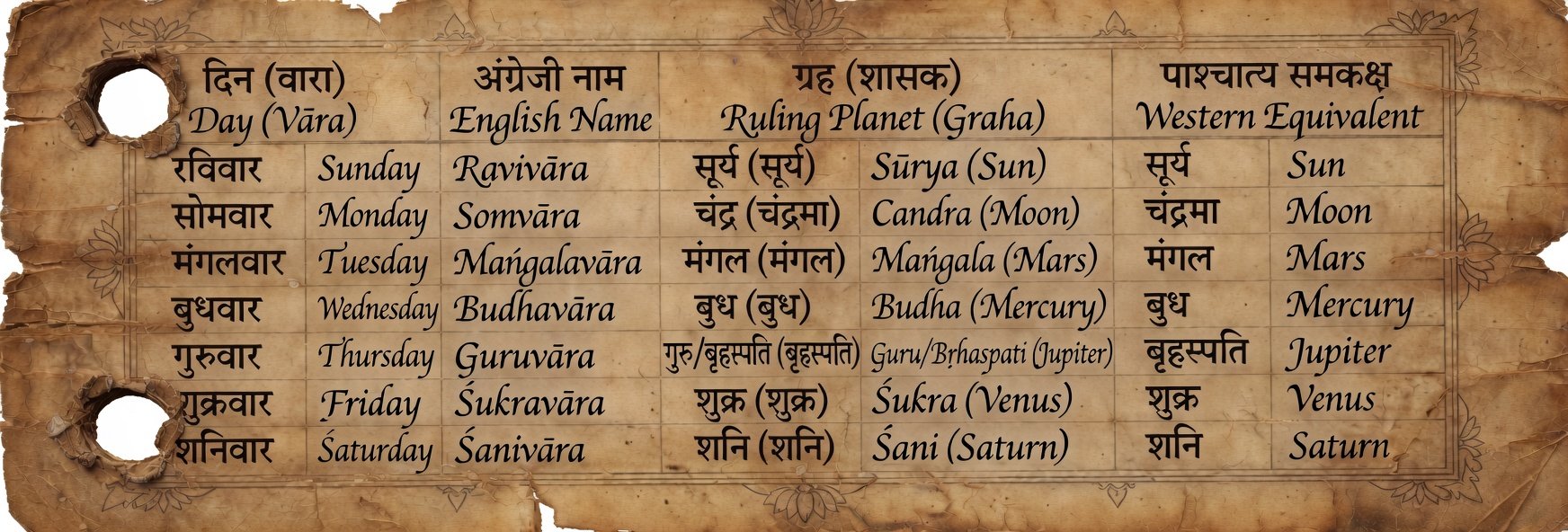
These names are not arbitrary translations from other cultures. They reflect the living intelligence of the planets as they dance around the Earth in the geocentric model used by classical Jyotiṣa.
The Astrological Science Behind the Week: The Hora System
The “creation” of the weekday order is explained through the *Hora*—the 24 planetary hours that make up each day from sunrise to sunrise. This system is beautifully detailed in the Surya Siddhanta (Bhugoladhyaya 78) and Aryabhatiya (Kala-Kriya Pada, Verse 16).
The ancient Ṛṣis observed that the planets move at different speeds relative to Earth. They arranged the seven grahas in the order of **increasing velocity** (from slowest to fastest):
Saturn → Jupiter → Mars → Sun → Venus → Mercury → Moon
This sequence is called the Chaldean order in Western astrology, but Vedic texts present it as a direct observation of planetary motion.
Here is the key principle:
Every day is divided into 24 equal *horas* (hours), starting at sunrise.
These horas are assigned to the planets in the repeating order above.
The first hora (the hour of sunrise) determines the lord of the entire day. The day is named after that planet.
Because 24 hours divided by 7 planets leaves a remainder of 3 (24 ÷ 7 = 3 remainder 3), each new day’s first hora shifts forward by **three planets** in the velocity sequence (or, equivalently, the fourth planet in successive counting).
Let’s see how this unfolds mathematically:
1. Suppose Saturday begins with Saturn ruling the first hora (as per the velocity order).
2. After 24 horas, the next sunrise falls on the planet that is 24 positions ahead → which is the **same as 3 positions ahead** in the cycle (because 24 mod 7 = 3).
3. From Saturn, skip 3: Jupiter (2), Mars (3), **Sun** → Sunday begins with the Sun.
4. From Sun, skip 3: Venus, Mercury, Moon → Monday.
5. From Moon, skip 3: Saturn, Jupiter, Mars → Tuesday.
6. From Mars, skip 3: Sun, Venus, Mercury → Wednesday.
7. From Mercury, skip 3: Moon, Saturn, Jupiter → Thursday.
8. From Jupiter, skip 3: Mars, Sun, Venus → Friday.
9. From Venus, skip 3: Mercury, Moon, Saturn → Saturday again.
This elegant permutation creates the exact sequence we follow today. The Surya Siddhanta states it concisely: “Starting from Saturn downward, the fourth graha is called the lord of the day.”
A Gift from Vedic Ṛṣis to the World
While some historians trace the seven-day week to Babylonian or Hellenistic sources, Vedic texts preserve the earliest systematic explanation tied to observable planetary speeds and the hora system. References appear in the Parasara Samhita, Aryabhatiya (5th century CE, but based on far older traditions), and the Surya Siddhanta—a text said to have been revealed by Sūrya Devata himself in ancient times.
The week is not a religious invention but a scientific calendrical tool derived from astronomy and astrology. It aligns human activity with planetary influences: the slow, karmic energy of Saturn on Śanivāra, the fiery action of Mars on Maṅgalvāra, the intellectual flow of Mercury on Budhvāra, and so on.
Why This Matters in Daily Life
Understanding the origin of the vaaras transforms how we live:
Ravivāra (Sun) favors self-confidence, leadership, and spiritual practice.
Somvāra (Moon) is ideal for emotions, family, and devotion to Śiva.
Maṅgalvara (Mars) is the day for courage, Hanuman worship, and overcoming obstacles.
And so forth.
Remedies, muhuratas (auspicious timings), and even fasting (vratas) are planned according to the ruling planet of the day.
The seven-day week is therefore not just a calendar convenience—it is a daily reminder that we live in harmony with the grahas. As the Surya Siddhanta reveals, the Ṛṣis did not “invent” the week; they decoded the divine rhythm already embedded in the movement of the heavens.
Next time you greet someone with “Happy Monday” or plan your week, remember: you are participating in a cosmic order gifted by the Vedic seers thousands of years ago—an order that still governs time across the entire planet today.
Jai Śrī Sūrya, Candra, and all the Navagrahas! May the wisdom of the vaaras guide your path. 🌞🪐